Search

GameIntrospection

Love and Hate for Gaming @GIntrospection

Category

Analysis

This is your Gaming on Data p2

What Developers are making?

A Tale of CrapWare

With a crash of thunder and spark of genius,
Came a brave little console, here to guide us.
But how will he get there, through peace or through wrath,
Little Wii-Knight, motion controls in-hand, creates his path.

The Developers Apirations

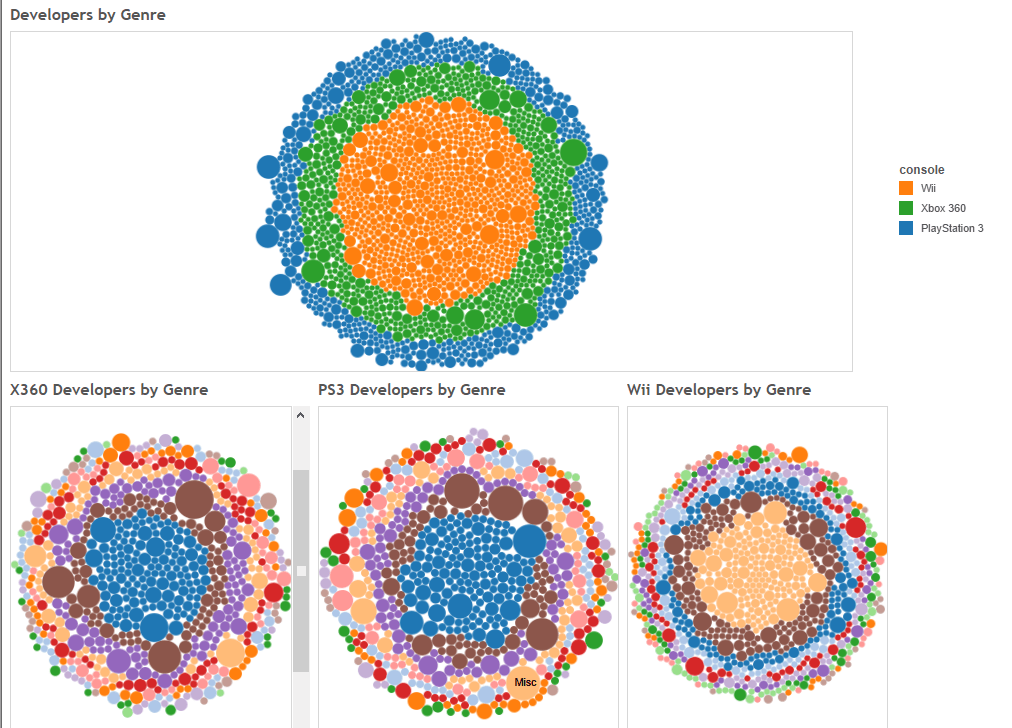
#Titles per genre per console. Top: Colored by Consoles Bottom: Colored by Genres Sorted by Most inside--Less outside
1. #Titles per genre per console.
Top: Colored by Consoles
Bottom: Colored by Genres
Sorted by Most inside–Less outside

What’s interesting about having all of this data at your disposal is seeing quickly how consoles can be remembered, or to drudge up old arguments with harder proof about what assumed at certain points but couldn’t really prove it yet. What the above shows is just how much developers spread across various genres on various consoles. Below are the pictures split-up.

Continue reading “This is your Gaming on Data p2”

Let’s Talk about Infamous: Second Sons

Infamous, the experiment in developing an original Superhero with the freedom of creating abilities and lore that’s untied to any pre-existing superhero universe. Two surprises from the PS3 generation was the ambition of Infamous and Prototype in creating an original open-world Superhero universe, but it would seem that Infamous had the staying power between the two with its 3rd installment released on the PS4. While the first 2 followed Cole and his very Spiderman-like origin story and his various continuous acts of self-sacrifice throughout the two games, we move on to Delsin and his X-Men-like origin story. The game tweaked a few aspects from the past few games but still did a great job at creating an original identity to both Delsin and the game instead of just another iteration of the same franchise. That doesn’t mean that everything went well, which is the topic for discussion to see how the experience can be overall different.

Continue reading “Let’s Talk about Infamous: Second Sons”

This is your Gaming on Data

Sit around and I’ll tell you a tale,

A tale that’ll make you think.

About the things you play that make your stay,

So grab yourself a drink.

What do we play?

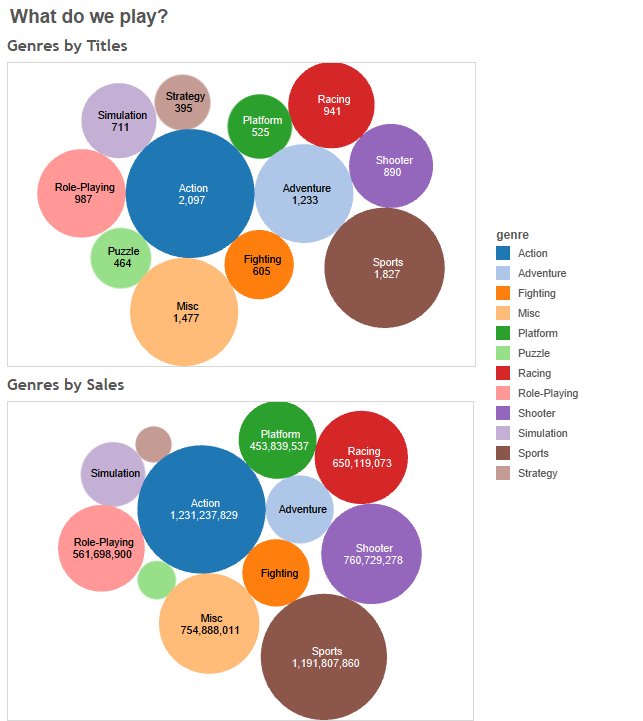
               What do we play

While not the most obvious image in the world, we can see a dissimilarity between what gets made (top) and what gets bought (bottom). If the trend of “what we like and what we’ll buy” were easily predictable, the number of sales per game would increase regularly across the genres. Compare the different genres for sales per title for yourself. You can see that Shooters do exceedingly well while Racing, Fighting, Miscellaneous games don’t.  But this is a very bland picture. Let’s try another view of it.

Continue reading “This is your Gaming on Data”

Why this game feels new – 2D Platformers

I’ve come to help you with your problems, so we can be free.

                Just how much room for improvement is there? When I look at a game, what gets me interested can vary greatly. Mechanics, story, perceptual shifts and so on are all aspects where the medium of gaming is leaps and bounds over the immersion of other media, but when going through the list of games month after month, there are very few examples that I can point to that “this is what gaming should exemplify and aspire to be, and the rest of you lot are the uninspired novelists hunting for words in a coffeeshop for hours a day.” I guess that’s a bit hypocritical because I’m in the middle of writing this at a coffeeshop-esqure environment, and have written at length in such an environment for quite some time because it is important to know where you work best and this environment is one of them for me. And I’d like to think that my level of output is greater than what some put out, especially after seeing how much time of others is spent on FB or random YouTube searches, but I digress.

The point is, most games that people tend to jump on the hype-train don’t have much to set themselves apart from predecessors and contemporaries, especially when there is so much more that can be done within the various genres that it makes it a chore to find a game that doesn’t “borrows heavily” from another which came out all of a few months prior.

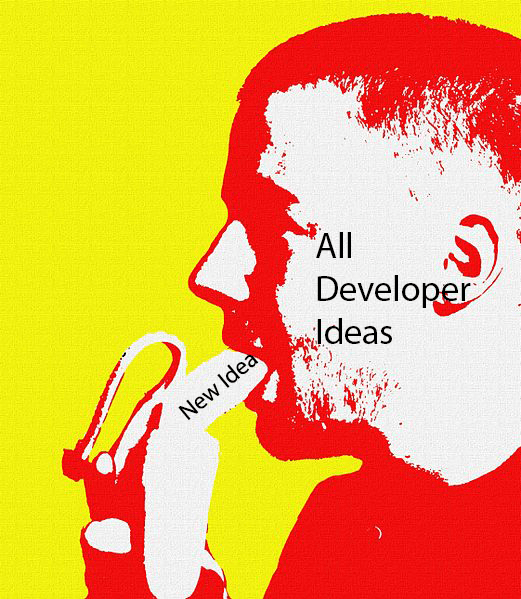
A lot of this seems to come from incestual idea-sharing, where there are only so many new ideas that come out and once an idea is created, it gets passed around like an answer sheet throughout a class of overachievers. Only a few people create new ideas every development team tries to figure out how they can use that idea in order to make the game seem current and ingenious.

Continue reading “Why this game feels new – 2D Platformers”

Let’s Talk about: Metal Gear Solid 5 – Ground Zeroes

       Where have all the cowboys gone.

              Let’s get all of the normal complaints out of the way. Metal Gear Solid: Ground Zeroes (MGSGZ) is a $30 demo, Keifer Suterland is not David Hayter and has some gritty vocal shoes to fill, the controls are too streamlined, and the narrative is very loose. All that being said, it was still a short but fun experience with some rough patches here and there. But I’m not just here to talk about my experience with the game, since it is a bit masturbatory to do so and everyone’s experience will differ, but there issome uniqueness to this MGS from previous ones because of the changes in design from sneaking down hallways to sneaking across the playground.

Continue reading “Let’s Talk about: Metal Gear Solid 5 – Ground Zeroes”

Tomb Raider and the Definition of Definitive

                Here’s lookin at you, kid.

Yes, Tomb Raider has been a bit stale for a long while and yes there hasn’t been a good iteration for very long time for the franchise. Guardian of Light was probably the only notable step in the right direction, but took the gameplay in a different direction from the traditional Tomb Raider games of the past. The big problem is that corridor crawling adventure games were clunky for the longest time and there was a big gap in the genre since the 3d era began. Tomb Raider, Resident Evil, even Mario and Zelda games made big advances in the 3d era, but of these early predecessors Tomb Raider holds up the least. Mario and Zelda prided themselves on fluid controls which made playing these games, even today, very enjoyable. The primitive interpretations of how players should be able to move translated well to the format that gamers are used to nowadays. Resident Evil controls like a 1920s era tank sold at discount from the crazy soviet from down the block. Turn in place, run forward. Turn in place some more, run forward. Fast mobility wasn’t a priority, and actually worked towards the games theming. Resident Evil is meant to be a survival horror game, so having fluid mobility takes away from the fear of the game. The awkwardness when controlling Jill or Chris adds to the panic when you’re trying to get away from the Zombie or Crimson making its way to eat some face. Tomb Raider controls in a similar fashion, with some more mobility than Resident Evil, but still extremely clunky by today’s standards, but since Tomb Raider isn’t a Survival Horror game, it makes the game all the more frustrating when revisiting the game with present eyes.

Continue reading “Tomb Raider and the Definition of Definitive”

On the Inside

                Do you remember waking up early on Saturday morning, rub your eyes to rid the sleepiness, eager to flip to the cartoon channel, in my day it would have been WB, FOX-box, Cartoon-Network or Nickelodeon, so you could indulge in a slew of cartoons about heroism, vengeance, comedic imaginariums or mysteries? Following you favorite characters every week, discovering their histories, watching how they get out of or into trouble on a weekly basis and building on the history through familiarity of the world created in front of us became such an integral part of how kids from my generation related to one another and how we developed our imaginative building blocks in further creating expansions on our imagination. But what’s important is that the adventures of our heroes didn’t feel repetitive and stale. Each week needed to bring something new into it, to add something to the world around it and to create a dilemma that is wholly unique that challenges the characters’ skills in new and interesting ways. This way there is a reason to keep coming back to watching the show, instead of missing a week and missing out on nothing substantial to the development of the characters that we know.

Continue reading “On the Inside”

QTEs and the Passive Game-Genie

Back onto Quick-time Events (QTEs) for a bit longer. The argument for QTEs is that they were initially designed to make the passive parts of the game more interactive. The flaw in this is that QTEs often detract from the immersion that is supposed to happen when experiencing a game and also leads to poor design choices that are justified by the inclusion of QTEs. We already talked about the Button Fairy pooping its button commands over the screen in anticipation for your payment of button flavored skittle distribution, but in this context it’s not just a matter of teaching the player poorly on adjusting to a situation and the Button Fairy remedying this by explicitly telling you what to do, but the Button Fairy is becoming the new distraction that “Hey, You’re in a game.” Much like the 555-XXXX phone number or the Wilhelm Scream in movies, when little moments like the pop-in of objects from Grand Theft Auto, inconsistent interaction options from any Open-World game, or in this case the Button Fairy becomes a constant reminder that this world is entirely made up. Keeping the player immersed in your medium is important in suspending the player’s disbelief when experiencing the medium, letting the player forgo much conscious thought and being led on by the medium to think, feel, and experience what the medium is trying to portray. If the medium does a good job at leading the player along, then they don’t realize that hours have gone by, they’ve missed a few meals and have probably binged on a full season of MadMen without realizing it and still what more to watch (this may or may not be from personal experience).

Continue reading “QTEs and the Passive Game-Genie”

QTEs, Obvious or Not

After spending hours on the new Tomb Raider, dodge duck dip dive and dodging everything that the game threw at me, I came to appreciate a lot about the game. On the other hand, there were some gaming sins that I see constantly in these kind of adventure games that instantly pull me out because of the absurdity in it, this case begin quick-time events (QTEs).

Why my problem with QTEs you may ask? On the one hand, it seems lazy with a lack of vision in teaching the player a special mechanic. In Tomb Raider’s case a kill-mechanic from melee combat or “close-call about to fall” mechanic from climbing. I can understand that it’s better to have some engagement from the player in order to have them feel like they’re actually causing something to happen,keeping the sense of active agency instead of pressing a button 3 seconds ago and watching Lara playing golf with someone’s face or watching her about to lose her grip from the crumbling Cliffside but make a quick recovery while you patiently watch and just wish that she’d move it along so you can get to the next area for puzzles and combat galore. Even a game like Uncharted (oh damn another Tomb Raider/Uncharted comparison so sue me) had plenty of QTEs in the first iteration of the game but toned down tremendously from them because of gripes from the fan-base being annoyed rather than intrigued by the concept. In fact, I’ve yet to meet anyone actually comment on a game saying “You know, [so and so] was really fun, but it had too downtime. It could’ve definitely done with more QTEs,” in which case I would make the point of unfriending them before another sentence came out of their mouth and that would be the end of the conversation. But that doesn’t mean Uncharted 2 didn’t have QTEs, they were just hidden much better and didn’t litter the game to an obscene degree. Instead, they were hidden as moments of reactions in “close-call moments” and set-pieces. So yes, there are in fact too many similarities between Tomb Raider and Uncharted, but the differences in the implementation are staggering although very minute in detail.

Continue reading “QTEs, Obvious or Not”

Create a free website or blog at WordPress.com.

Up ↑