Search

GameIntrospection

Love and Hate for Gaming @GIntrospection

Category

Analysis

Child of Light and the new “Indie” scene

Child of Light is another one of those games that is hard to categorize. It’s a game marketed as an indie game but clearly developed by a major developer, Ubisoft, which can be fairly misleading for players if they don’t pay attention. This usually means that Child of Light gets graded on an easier scale because of the “indie” aspect in mind and while I don’t believe it should, I still think that the game is exceptionally done for what it is.

If only all games looked like a PBS storybook.

It’s essentially a basic platfomer with classic JRPG combat using elements to try and make the battle system more active than simply being “turn-based”, a clearly defined art-style that captures a whimsy of 80-90s European ‘Storybook’ Animation, a soundscape that’s as euphoric and resounds with the environment as Ni no Kuni (PS3) and one of the only other games in the past few years that made me enjoy an older style JRPG (the other actually being Ni no Kuni). If you’ve read any other articles of me criticizing The Final Fantasy franchise, the reigning poster child of what’s right and wrong with JRPGs, you’d know that I’m not entirely too happy with the current direction of the franchise so it’s great to see another game that can get me to be excited about an RPG that is of a slower pace like older Final Fantasies.

Continue reading “Child of Light and the new “Indie” scene”

Dialogue Delivery part 4: Short but Provocative

The story thus far:

Player-Paced Dialogue Delivery

Character-Paced Delivery w/ No Dialogue

Character-Paced Delivery w/ Verbose Dialogue


Verbosity in games, much like any medium, is hard to get right. The dynamics of a game and the habits of a gamer are those that contribute a response towards quick reward systems. Run right and jump = Progression. Turn on console -> Start Game -> Join Game -> Start Killing things, all in a matter of a minute or two. But becoming programmed to this sort of habit goes against what verbosity tries to deliver. We’ve talked about how being verbose can be used correctly before, about not letting the mechanism for delivering the dialogue interfere with the agency of the player as they go about through the game. The delivery should only interfere when absolutely necessary but not for too long otherwise it pulls the player out from the immediate sense gratification that a game presents, but it means that shortened dialogue delivery needs to be discussed.

Continue reading “Dialogue Delivery part 4: Short but Provocative”

How overrated/underrated are games to critics/gamers? You can almost see the fanboy bias in the graph sometimes

Dialogue Delivery part 3: The Wind Blows Long

When a character speaks, the player listens. When a character speaks too much, the player tunes out. Continuing with our look at Dialogue Delivery systems, we still need to look at when character-paced acting is mixed with dialogue as a means of delivering story, character development and plot points. The previous two can be found here and here which discuss Player-paced storytelling and character-paced dialogue-less storytelling, respectively.

There are various means for pushing dialogue onto the player. Text-based, dialogue-based, interpretive gestures and symbols. I don’t want to focus too heavily on what they are actually delivering, but instead focus on how each will be received.

Information delivery is important to think about when designing a game because you’re asking a lot of the player as they try and soak in the information presented. You’re dropping the player into a conversation among other people and expecting them to take the conversation as seriously as the other participants. If there is too much information, it becomes a chore to participate in the conversation.

Continue reading “Dialogue Delivery part 3: The Wind Blows Long”

Critics and Players likely don't agree about much, except that they like to play games.
Critics and Players likely don’t agree about much, except that they like to play games.

Dialogue Delivery: What Story Do You Think It Is? pt2

We talked about the way dialogue and story elements were delivered in older generation-style games in the previous post which talks about player-paced plot-delivery and how clunky this mechanism is, especially when compared to the evolution of plot-delivery and character-paced delivery that we’ll discuss in this post.

There are two means of delivering the dialogue gaming, using either the In-Game Engine (IGE) or using pre-rendered Full-Motion Video (FMVs).


The IGE delivery uses the in-game gestures that the characters are normally seen using. They are made up of primitive gestures that when tied in sequence make up the acted emotions of the scene. These primitives are generally simple gestures like move over to point A, waving your hand to say “Hi”, putting your hand to your chin to show “I’m Thinking,” looking down to show “That’s Depressing/Disappointing.” For those who’ve played any MMORPG, these are simple emotes, showing a generalization of what emotion you’re trying to portray, but are blocky and look irregular because the motions aren’t fluid and are 1-dimensional.

FMVs, on the other hand, are scenes crafted by hand or by motion-capture suits in order to have the choreography and the dynamics of the scene seem realistic, being lived out on screen, rather than actions being dictated to them “Now look angry. Now look frustrated. Now look like you’ve been inspired with an idea.” In PS1/N64 ear games, FMVs were choreographed by the 3d artists, meticulously moving the arms and legs to proper locations, keyframing the locations that characters needed to be at in order to make the scene seem believable and compelling. Nowadays there is a mixture of this 3d-Artist ballet intermingled with real actors providing motion-captured animations so that the timing, the delivery and the drama feel organic because of its timing, the subtle strenuousness of basic movement when walking across a room while monologuing.

But these are the only the delivery systems for plot and dialogue, but the actual content being delivered can vary and impact how the player engages and experiences in the games themselves.

Continue reading “Dialogue Delivery: What Story Do You Think It Is? pt2”

Dialogue Delivery: Where Actions and Emotions Stray

When the character’s emotions don’t match their actions, it looks extremely odd. Like someone is just reading lines from a script, trying to grasp at but not completely understanding how they’re supposed to act, voice, or react when something dramatic happens. They stand there making some idle gesture while some sounds come out of their mouth, or the player is freely moving the characters around while dialogue is being played in the background and the player is supposed to understand the emotion being portrayed based on a partially synced audio/video? This is the problem when companies develop a competency for portraying emotion through just dialogue or just video. With many developers not able to completely develop an understanding of getting their game’s acting and dialogue to be wholly believable, I wanted to at least delve into the different mechanisms developers can use in order to connect emotion, story, and motivation to the player.

Continue reading “Dialogue Delivery: Where Actions and Emotions Stray”

This is your Gaming on Data p3


When two must fight over one

And both are similar to one another,
They must evolve.
If one becomes successful,
The other must find a way to win,
Or find another to pursue.
What are developers making?

A Tale of Two Consoles

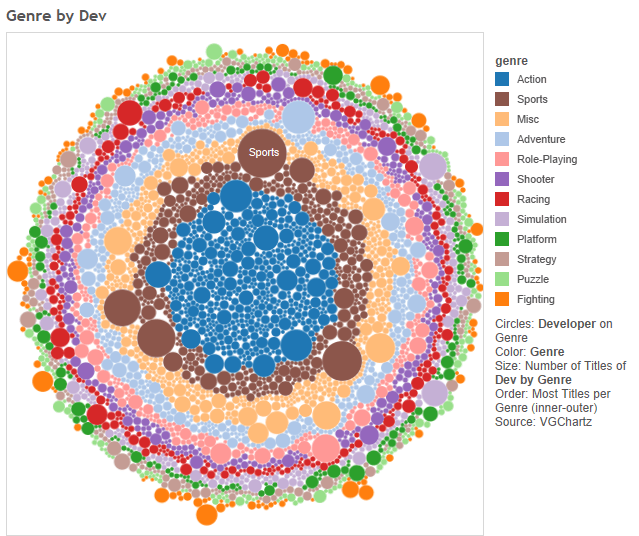
Circles. Circles everywhere. But not a drop to drink. Circles: Dev by Genre Color: Genre Size: Number titles of Dev in Genre Sort: Most Titles in Genre (inner--outer) Source: VGChartz
[1] Circles. Circles everywhere. But not a drop to drink.
Circles: Dev by Genre
Color: Genre
Size: Number titles of Dev in Genre
Sort: Most Titles in Genre (inner–outer)
Source: VGChartz
When a game is developed, developers try to keep in mind the audience that they are trying to reach. What the above [1] shows is where their focus is being put with many games opting to stay in the traditionally popular categories of Action and Sports, with fewer and fewer developers focusing on genres that typically swing towards one series in particular. Fighting games have their Street Fighters taking up the majority of its audience, Gran Turismo taking up the Racing genre, etc… But what’s important is to focus on the differences between the consoles, in particular the PS3 and the Xbox 360 since we already focus on the Wii last time and the conclusion was that it was a gimmick machine that printed money for Nintendo and Ubisoft, but rarely for any other developer. LINK

This is not a tale of triumph, one of mischief or of woe.
It is a tale of rivals, finding a crowd for which they’d know.

Continue reading “This is your Gaming on Data p3”

Persistence to Play More

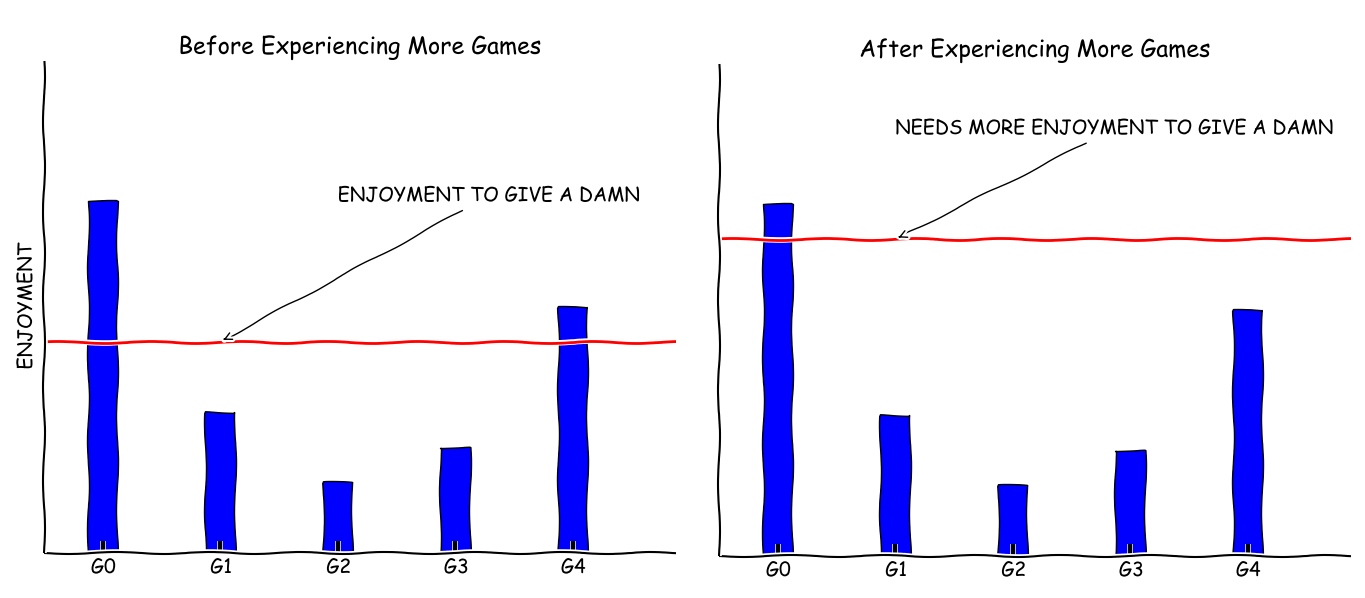
I remember a time when I was a kid where I would go to Toys ‘R Us once in a blue moon and pick up a game, whatever looked like would be fun, meaning something Mario, something Teenage Mutant Ninja Turtles, something Kirby, etc… I would go home, pop the cartridge into the console and play. Then the next day comes by and I’d keep playing. Weeks may go by without touching the thing, but I’d come back to playing it at some point. I’d even go back to games rented from Blockbuster. If the game seemed like fun at the time and they had a copy in stock, I’d pick it up again and keep playing it. After some time, my game collection kept getting bigger, games kept getting longer, and my time to play them kept getting cut due to the “responsible” things I needed to get done. Because of this, there arrived a time when I would stop revisiting old games. Games that were good got revisted more often than others, but even bad games were revisited in the past. Maybe because my selection is too vast, spending time on shitty games isn’t worth the time, and the mentality of “why replay something when I have another game waiting to be played” started to become the norm. I know if I had to spend $60 on a game in my early teens, I would have kept the game in my roster continuously until I accumulated at least 20+ hours for the game, unless the game was really just horrendous. But at what point do we start to abandon the games that we buy? And why would we abandon playing the game after only completing the game once or not even finishing the game at all?

Continue reading “Persistence to Play More”

Create a free website or blog at WordPress.com.

Up ↑