Search

GameIntrospection

Love and Hate for Gaming @GIntrospection

Tag

Analysis

Player’s Agency and Lack of it for Suspense Games

After watching a few streamers play through Five Nights at Freddy’s it reminded me that the player’s agency, their ability to control their actions to elicit outcomes, is extremely important to create a consonance (harmony) between the player and the game. And it is when that agency is reduced or limited is when cognitive dissonance sets in. You’re playing a game and you aren’t jiving with it. The actions that you want to do and the reactions that you’re getting on screen aren’t connecting. In psychological terms, you have multiple mental beliefs that are conflicting with one another causing discomfort – cognitive dissonance. The actions that you want to do and the actions that you’re allowed to do are in conflict, causing the anxiety and discomfort. But in a game like Five Nights at Freddy’s (FNAF) or any other suspense game designed to instill paranoia and anxiety, it’s the lack of agency that helps to inspire these emotions.

We can always look back on games the past games like Resident Evil where Jill Valentine moved like a Old 70s Buick, or Panzer Artillery Tank, which actually worked as a benefit to the game. The lack of mobility took away any agility that we could have had and made even the slightest danger – zombie, hound, Lisa Trevor – much more tension-rising than normal because we knew maneuvering pass them was a chore and a half.

Maybe Jill can finally be the "Master of Lockpicking"
This isn’t entirely accurate. The character in the image can probably control better than Jill.

Continue reading “Player’s Agency and Lack of it for Suspense Games”

Growing Up with Gaming (short essay)

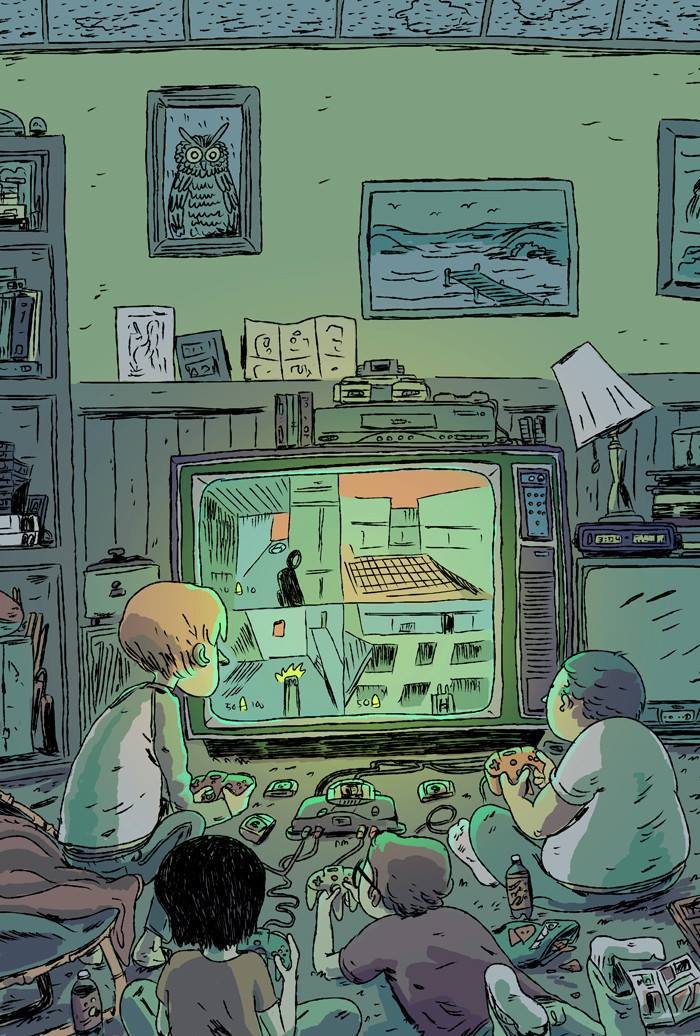
It occurred to me just before I sat down to write that people in my generation are the first to grow up not knowing what life was like before gaming (as we know it) was a thing. Being born between 1984 and 1990 when the NES reigned supreme over the gaming masses, those of us born in this era grew up with names like Mario, Link and Megaman as a constant throughout our lives. Just like us from the past, those born around the 2001 will never know of an age without the name Master Chief in their gaming vernacular. Or kids the were born in the mid-90s never knowing a time before the Internet in every household, or  2007-ish without a smartphone or tablet in your household.

What’s important to remember is that while many game designers were around and developing games while we were growing up, there is a fresh generation of minds that have been exposed to a rich history of game design, good and bad. This might be an incestuous relationship because our ideas tend to be anchored to past experiences so our inspirations are “borrowed” from ideas that we’ve played in the past instead of coming up with something completely original. Regardless, our game-design parents and mentors helped to foster our experiences, our morals, our social dilemmas, our peaks and pits through our gaming experiences. Our games were growing up while we were growing up.

Every one should check out Zac Gormon at http://magicalgametime.com/ His work hits so many feels buttons, it's not even fair
Every one should check out Zac Gormon at http://magicalgametime.com/ His work hits so many feels buttons, it’s not even fair

Continue reading “Growing Up with Gaming (short essay)”

Are Current Movies and Games Going to Feel Dated Soon?

You turn on Netflix. You see the opening scenes. There’s a hustle-and-bustle going on with the crowd but not a main character to be identifiable yet. The shooting feels clunky. The music has a heavy synth sound in its tones. There’s not a black person in sight, unless it’s the main character or a homeless person in the movie. You have the suspicion that you’re watching an 80s movie or an early 90s movie.

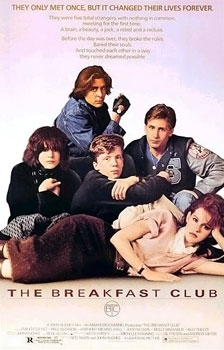
We can pull what movies feel like a period-movie with only a few moments of watching a scene. For the current generation of young adults, it’s almost instinctual to know when many movies were created because of the tropes that these movies execute. Group of misfits learns to come together? Is it in a high school or outside of it? Is the hair outrageous? What about the Clothing? If you answer yes to all but the clothing, then the movie is probably a John Hughes movie and you’re probably watching the Breakfast Club, let’s be honest. The point is that what are the tropes that will define the movies that we watch today?

The_Breakfast_Club

Continue reading “Are Current Movies and Games Going to Feel Dated Soon?”

Game Idea: Draw your enemies away – RTS (Controller: Wii U Pad)

Game Idea: Draw your enemies away – RTS (Wii U Pad)

The Game:

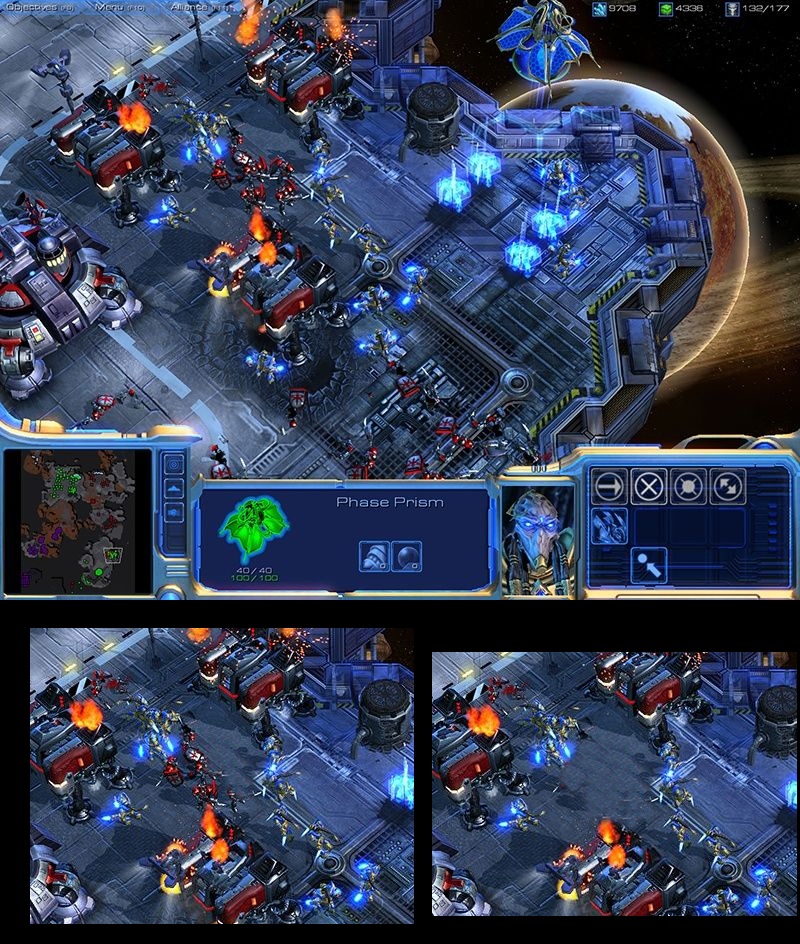
The idea is this: you’re doing the standard “make + build + kill” deployable units thing that Real-Time-Strategy games do (RTS) or even TTS (Turn-based Strategy games. To make things interesting you have a “draw”-ability that is limited use per game, but it allows you to set the stage in your favor when you’re on the offense or defense.

Continue reading “Game Idea: Draw your enemies away – RTS (Controller: Wii U Pad)”

Let’s Talk about: Crypt of the Necrodancer

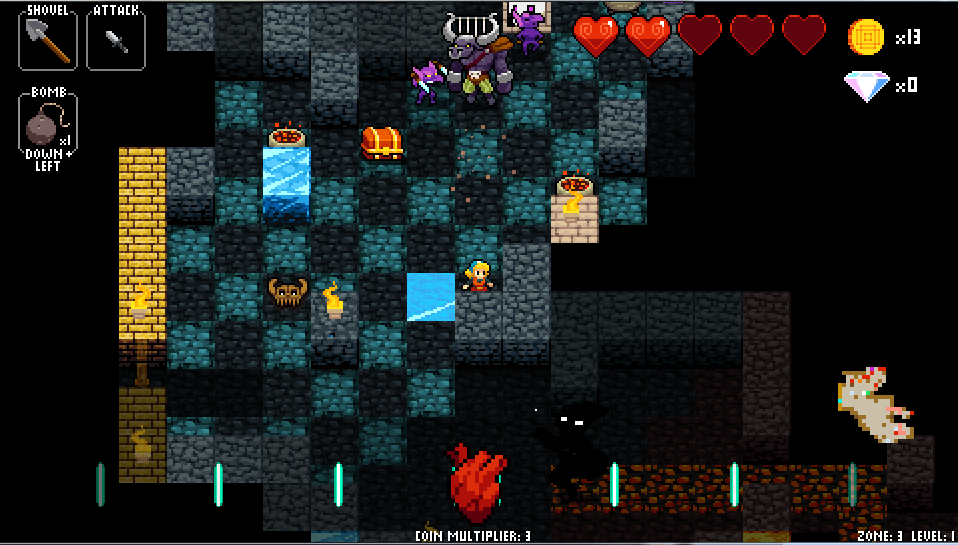
The game came out about a month ago on Early Access Steam (7/30) and I didn’t know how I wanted to approach the game at first. The game is fun, the music is addicting but I found myself turning away from playing it from time to time. For a rogue-like, it does its job of creating a high-replayability by having generated dungeons for all stages, daily challenges, and different playthrough experiences because of the randomized weapons, power-ups and enemies.

Good music, hard learning experience.

What I was shying away from was the other part of rogue-like games, the “keep you on your toes” part. The game’s mechanics are simple. You move to the beat. You attack to the beat. You create paths through walls to the beat. But this also means that you learn about your enemies to the beat. Once you get past the first few enemies learned through the tutorial, you quickly find enemies where you don’t know their attack patterns and movements. Normally, when you come across something that you’ve not experienced prior, you can take your time to figure out how to approach these kinds of enemies, but with the restrictions of actions per beat, timed length of the song/stages and other enemies trying to eat your face by throwing their heads in your direction, it makes it difficult to learn and understand an enemy. It makes it even more frustrating when you die to that enemy and you haven’t learned a gosh-dern thing about how or why you died.

Continue reading “Let’s Talk about: Crypt of the Necrodancer”

PAX Prime 2014 Goal – Story

The theme of this year’s PAX for me is…Story.

Creating a well crafted story and conveying differences in perspectives across your audience, or across a mass audience. As much as I want to join in on the more technical Game Development panels, or the Data Analytics panels like “Games User Research” or “Awesome Video Game Data”, I want there to be a growth in my abilities at this years PAX. There are plenty of great panels to go to, plenty of amazing games to try ( Indie and Triple-A), plenty of cool people to meet and greet, but there needs to be some cohesion in the experience.

Yum yum in my thumb thumb.

You go to these trade-shows, tech conferences and celebratory events and you need to come out of it with something that wasn’t in your arsenal beforehand. Knowledge, skill, a developed social circle. There should be growth somewhere to make these things worthwhile. Else-wise, you’re just blowing a few hundred dollars to go up to Seattle for a few days. This isn’t a bad plan, but there’s plenty else to do in Seattle than be in a mass of sweat and vested fedoras (sorry Yahtzee, don’t hate me) overflowing through a few thousand square feet of convention room hallway.

Continue reading “PAX Prime 2014 Goal – Story”

Game Idea: Ico (if Yorda was a dog that needed to poop)

Game Idea: Ico (but if Yorda was a dog that needed to poop really badly)

This isn’t really a completely original game mechanic per-se, because the description of the game is completely within the header. For completeness-sake, let’s go about describing this, though.

You know that look a dog gets as they are pooping. That pathetic, helpless, protect me face? There’s a reason for it.

Continue reading “Game Idea: Ico (if Yorda was a dog that needed to poop)”

Taking Yourself Too Seriously, Gaming.

The gap between gaming as a medium to be taken seriously and lightly has been narrowing in many storytelling genres. We can find well scripted humor in the midst in contextual-placement of the player in games like Portal or The Stanley Parable, drama in actions that we choose to do or are helpless in preventing in The Last of Us or Bioshock Infinite, or walk through the blackness of our paranoia in Amnesia or Slender Man. What’s interesting though is that other mediums like movies had an extremely rough time getting the average story in a game to not feel forced or that the campiness from genre films hasn’t particularly translated well in gaming as of yet.

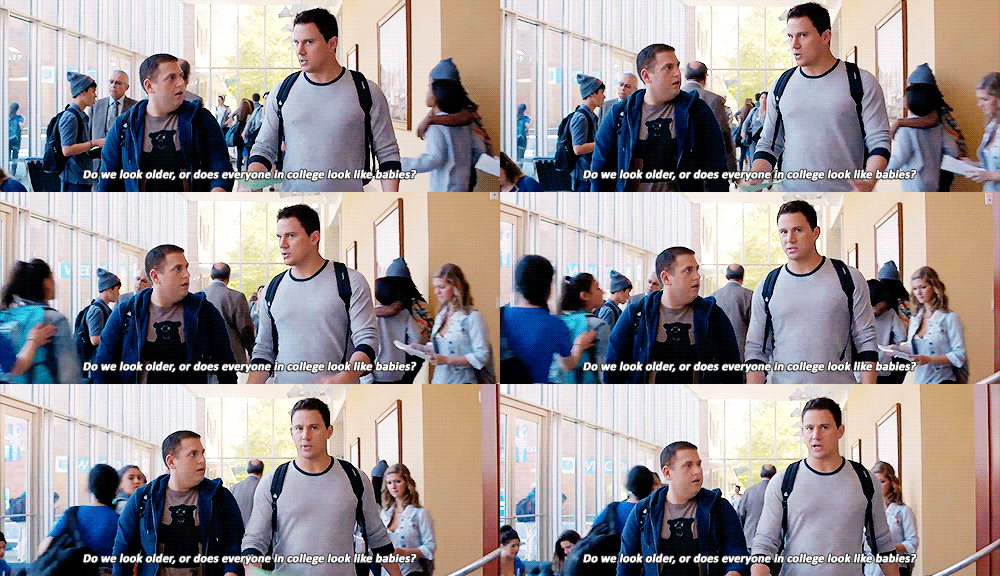
Don’t get me wrong, there is a difference between campiness and cliché, and it’s easy to spot one over the other. Cliché is taking what we’re used to and regurgitating it back to us in a form that we are already used to seeing. Campy is taking what we’re used to and being almost self-referential to it by exaggerating the parts that make it campy. I don’t mean self-referential like some side-character saying “Do you think this is a game?” or “What kind of game do you think this it?” because this is already a cliché and completely un-original. The idea of the campy-self-referential is that you make the cliché feel original. Being campy isn’t a bad thing either. Campiness worked in the reboot of 21/22 Jump Street, Hot Tub Time Machine and the more recent Guardians of the Galaxy.

Oh you two. Never the dissapointment
Oh you two. Never the disappointment

Continue reading “Taking Yourself Too Seriously, Gaming.”

Game Idea: Suspense with Oculus + A Rentable Room

Game Idea: Suspense-Horror with Oculus with Tactile Information via physical objects

The Mechanic

Oculus game again. You and your Oculus are in a small room, 10 x 10, or the standard living space in downtown San Francisco for your month’s paycheck. But the room is set up with hundreds of tiny jets, like the ones from Jacuzzis and jets are laced throughout all planes of the room. The floor, the walls, the room. Maybe there are obstacles around the room, with air jets on them as well. But here’s the fun part, it’s a chase game, e.g. SlenderMan or If Only.

Maybe this many is a bit overboard, but you get the idea.

I talked about different controller types lending itself to the birth of different gameplay mechanics here, well the new interactive medium will be the room itself. Suspense/thriller games get you to jump by two main means, jump scares and creep-factor. But now you have a new set of mediums in the room to mess with your adrenal-glands.

Continue reading “Game Idea: Suspense with Oculus + A Rentable Room”

Create a free website or blog at WordPress.com.

Up ↑