


When a character speaks, the player listens. When a character speaks too much, the player tunes out. Continuing with our look at Dialogue Delivery systems, we still need to look at when character-paced acting is mixed with dialogue as a means of delivering story, character development and plot points. The previous two can be found here and here which discuss Player-paced storytelling and character-paced dialogue-less storytelling, respectively.
There are various means for pushing dialogue onto the player. Text-based, dialogue-based, interpretive gestures and symbols. I don’t want to focus too heavily on what they are actually delivering, but instead focus on how each will be received.
Information delivery is important to think about when designing a game because you’re asking a lot of the player as they try and soak in the information presented. You’re dropping the player into a conversation among other people and expecting them to take the conversation as seriously as the other participants. If there is too much information, it becomes a chore to participate in the conversation.
Continue reading “Dialogue Delivery part 3: The Wind Blows Long”


When the character’s emotions don’t match their actions, it looks extremely odd. Like someone is just reading lines from a script, trying to grasp at but not completely understanding how they’re supposed to act, voice, or react when something dramatic happens. They stand there making some idle gesture while some sounds come out of their mouth, or the player is freely moving the characters around while dialogue is being played in the background and the player is supposed to understand the emotion being portrayed based on a partially synced audio/video? This is the problem when companies develop a competency for portraying emotion through just dialogue or just video. With many developers not able to completely develop an understanding of getting their game’s acting and dialogue to be wholly believable, I wanted to at least delve into the different mechanisms developers can use in order to connect emotion, story, and motivation to the player.
Continue reading “Dialogue Delivery: Where Actions and Emotions Stray”
When two must fight over one
And both are similar to one another,
They must evolve.
If one becomes successful,
The other must find a way to win,
Or find another to pursue.
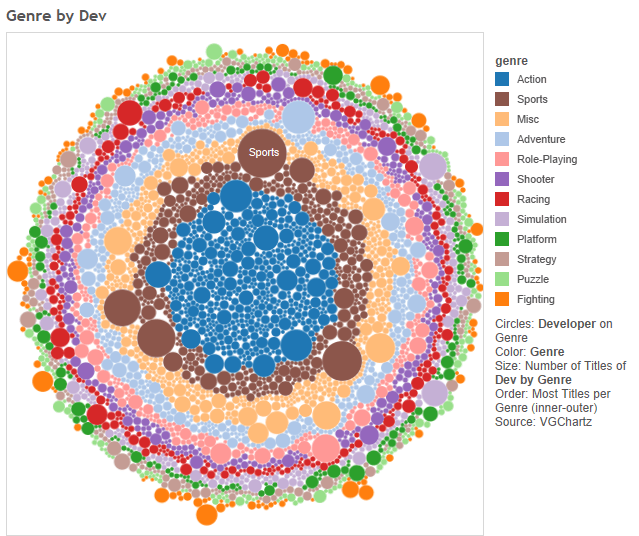
What are developers making?
A Tale of Two Consoles

Circles: Dev by Genre
Color: Genre
Size: Number titles of Dev in Genre
Sort: Most Titles in Genre (inner–outer)
Source: VGChartz
This is not a tale of triumph, one of mischief or of woe.
It is a tale of rivals, finding a crowd for which they’d know.
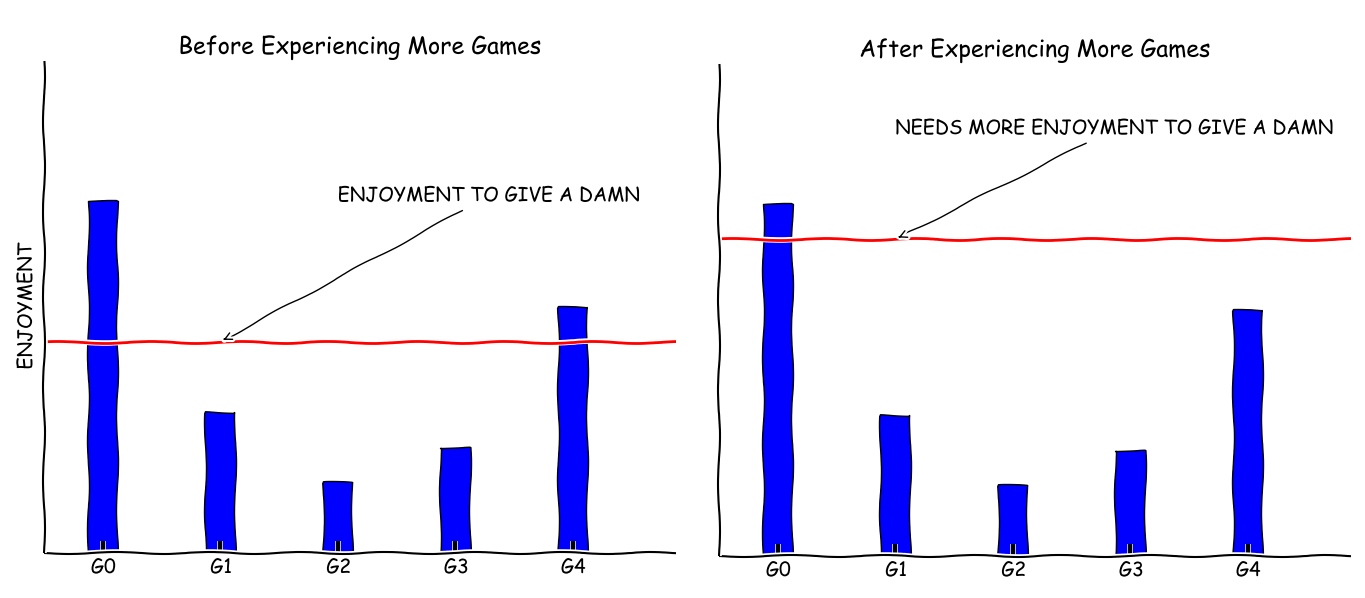
I remember a time when I was a kid where I would go to Toys ‘R Us once in a blue moon and pick up a game, whatever looked like would be fun, meaning something Mario, something Teenage Mutant Ninja Turtles, something Kirby, etc… I would go home, pop the cartridge into the console and play. Then the next day comes by and I’d keep playing. Weeks may go by without touching the thing, but I’d come back to playing it at some point. I’d even go back to games rented from Blockbuster. If the game seemed like fun at the time and they had a copy in stock, I’d pick it up again and keep playing it. After some time, my game collection kept getting bigger, games kept getting longer, and my time to play them kept getting cut due to the “responsible” things I needed to get done. Because of this, there arrived a time when I would stop revisiting old games. Games that were good got revisted more often than others, but even bad games were revisited in the past. Maybe because my selection is too vast, spending time on shitty games isn’t worth the time, and the mentality of “why replay something when I have another game waiting to be played” started to become the norm. I know if I had to spend $60 on a game in my early teens, I would have kept the game in my roster continuously until I accumulated at least 20+ hours for the game, unless the game was really just horrendous. But at what point do we start to abandon the games that we buy? And why would we abandon playing the game after only completing the game once or not even finishing the game at all?
 GameIntrospection