Search

GameIntrospection

Love and Hate for Gaming @GIntrospection

Category

Gaming

E3 Game Dump – Entwined

Entwined_04

Genre: Rhythmic/Atmospheric

Console: PS4. Plans for PS3/Vita Cross-Buy

Controls

Twin stick – asynchronous

The basics are that you move the left stick for the Red character and the right for the Blue. The player then tries to go through the correctly colored gates until their “sync” meter (the top bars) fill up, extend and gently touch tips so they both synergize together.

The Rhythmic part comes in where the gates and sounds played arrive on beat to the background music, making the experience more unique to each player and helps build the atmosphere to each of its soundscapes.
Continue reading “E3 Game Dump – Entwined”

Teaching the player: Prelude and First Screens

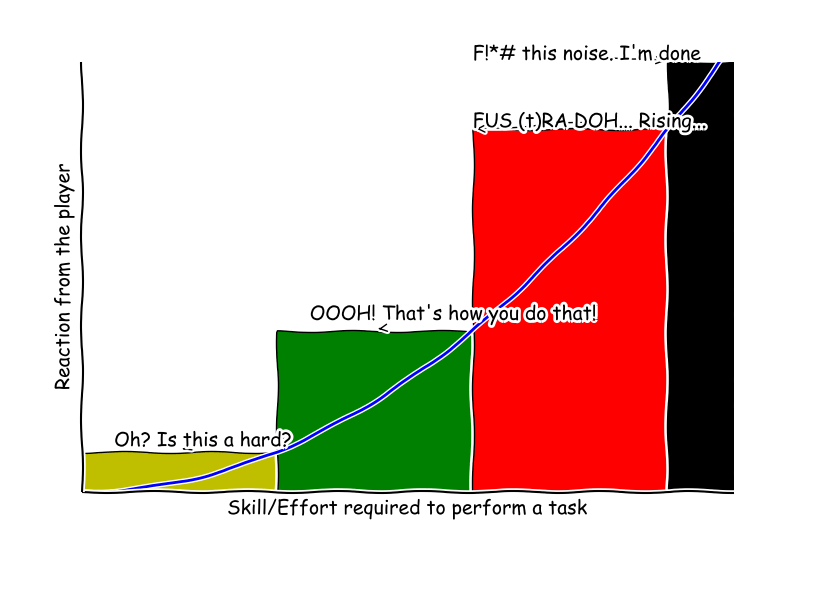
You know what sucks in a game? Being force fed how you are supposed to interact with the world. You know what also sucks? Not knowing what to do, or knowing exactly what to do and making it nearly impossible to accomplish. There are a myriad of ways this can be done correctly or incorrectly and I’m sure there were active decisions as to why certain designs were chosen, but they all contribute to or take away from the player experience in one form or another and it’s left to a good level designer to understand what works best for their game and how to design the level around making the most out of the player experience.

Continue reading “Teaching the player: Prelude and First Screens”

Dialogue Delivery p5: How, not what.

Obligatory Past Post Countdown:

Player Paced Dialogue Delivery [link]

Character Paced Non-verbal Dialogue Delivery [link]

Character Paced Verbose Dialogue Delivery [link]

Character Paced Short-Form Dialogue Delivery [link]


Stepping away from the focus on “what” is said, it’s still important to talk about the setting of the delivery. For all of the previous articles, we’ve only talked about dialogue and plot points delivered through extremely disruptive cutscenes. I don’t mean disruptive in the sense that it causes the player to drop the controller out of frustration, but disruptive in that it shifts your agency from playing to watching for a short while. The player stops “playing” the game and starts “watching” the game for a short or extended amount of time. This doesn’t necessarily cause a distraction for the player, but it does give an idea to the pacing of the game for the player. If the cutscenes feel long and troublesome, it can quickly demotivate the player from wanting to continue playing the game. So today, let’s focus on the two major pacing types used in gaming.

Continue reading “Dialogue Delivery p5: How, not what.”

Child of Light and the new “Indie” scene

Child of Light is another one of those games that is hard to categorize. It’s a game marketed as an indie game but clearly developed by a major developer, Ubisoft, which can be fairly misleading for players if they don’t pay attention. This usually means that Child of Light gets graded on an easier scale because of the “indie” aspect in mind and while I don’t believe it should, I still think that the game is exceptionally done for what it is.

If only all games looked like a PBS storybook.

It’s essentially a basic platfomer with classic JRPG combat using elements to try and make the battle system more active than simply being “turn-based”, a clearly defined art-style that captures a whimsy of 80-90s European ‘Storybook’ Animation, a soundscape that’s as euphoric and resounds with the environment as Ni no Kuni (PS3) and one of the only other games in the past few years that made me enjoy an older style JRPG (the other actually being Ni no Kuni). If you’ve read any other articles of me criticizing The Final Fantasy franchise, the reigning poster child of what’s right and wrong with JRPGs, you’d know that I’m not entirely too happy with the current direction of the franchise so it’s great to see another game that can get me to be excited about an RPG that is of a slower pace like older Final Fantasies.

Continue reading “Child of Light and the new “Indie” scene”

Dialogue Delivery part 4: Short but Provocative

The story thus far:

Player-Paced Dialogue Delivery

Character-Paced Delivery w/ No Dialogue

Character-Paced Delivery w/ Verbose Dialogue


Verbosity in games, much like any medium, is hard to get right. The dynamics of a game and the habits of a gamer are those that contribute a response towards quick reward systems. Run right and jump = Progression. Turn on console -> Start Game -> Join Game -> Start Killing things, all in a matter of a minute or two. But becoming programmed to this sort of habit goes against what verbosity tries to deliver. We’ve talked about how being verbose can be used correctly before, about not letting the mechanism for delivering the dialogue interfere with the agency of the player as they go about through the game. The delivery should only interfere when absolutely necessary but not for too long otherwise it pulls the player out from the immediate sense gratification that a game presents, but it means that shortened dialogue delivery needs to be discussed.

Continue reading “Dialogue Delivery part 4: Short but Provocative”

How overrated/underrated are games to critics/gamers? You can almost see the fanboy bias in the graph sometimes

Dialogue Delivery part 3: The Wind Blows Long

When a character speaks, the player listens. When a character speaks too much, the player tunes out. Continuing with our look at Dialogue Delivery systems, we still need to look at when character-paced acting is mixed with dialogue as a means of delivering story, character development and plot points. The previous two can be found here and here which discuss Player-paced storytelling and character-paced dialogue-less storytelling, respectively.

There are various means for pushing dialogue onto the player. Text-based, dialogue-based, interpretive gestures and symbols. I don’t want to focus too heavily on what they are actually delivering, but instead focus on how each will be received.

Information delivery is important to think about when designing a game because you’re asking a lot of the player as they try and soak in the information presented. You’re dropping the player into a conversation among other people and expecting them to take the conversation as seriously as the other participants. If there is too much information, it becomes a chore to participate in the conversation.

Continue reading “Dialogue Delivery part 3: The Wind Blows Long”

Critics and Players likely don't agree about much, except that they like to play games.
Critics and Players likely don’t agree about much, except that they like to play games.

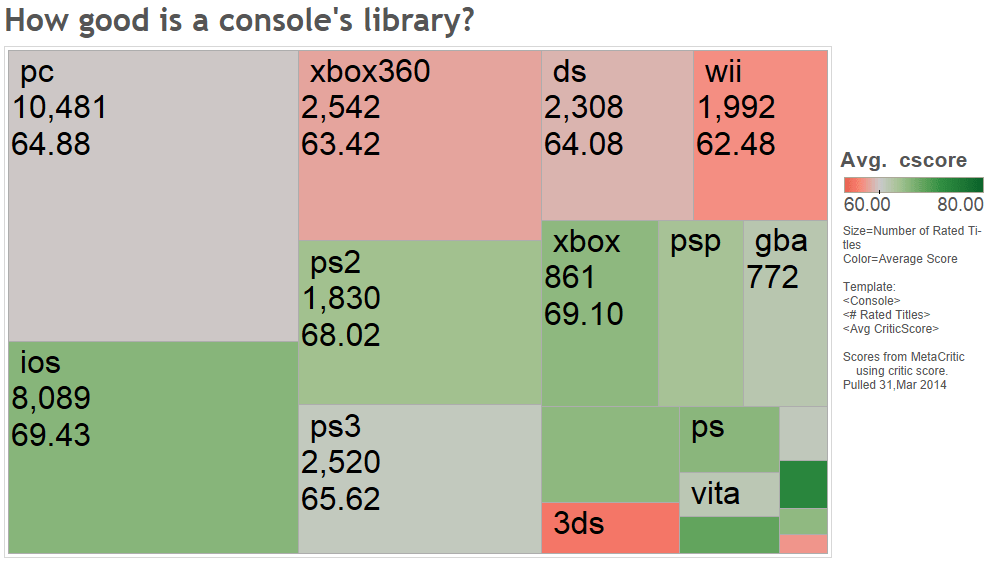
How good is a console's library?

So many games per console, but not all are looked upon equally.

Blog at WordPress.com.

Up ↑