Search

GameIntrospection

Love and Hate for Gaming @GIntrospection

Category

Analysis

Forever a Fan: A game’s constant reprise to mind

A funny thing happens when I walk by an arcade. My neck cranes, scanning the room and if I gaze on a series of the flashing arrows scrolling up a screen my eyes lock onto the machine and my body tries to move towards the machine on instinct. The feeling intensifies if the machine happens to be part of the few generations that had the best track list, but regardless of the version there is always an urge and a rush of the good brain chemicals that get me feeling excited and anxious to hop on the machine and give it another round for old times sake. The machine, if you hadn’t guessed was a DDR machine. If you talked to 13-year-old me and told him that I’d be working at a place where there were several DDR machines in the area with easy access to, he’d be ecstatic because what 13-year-old me thought was that I’d be a fan of the series for life. Maybe that was immature thinking, but the more places that I pass where there’s a DDR machine there or the disappointment that I find when there isn’t when I’d thought there would be, the more I believe I had it right back then, though my reasoning was wrong for it.

You can call it nostalgia or not being able to let go of past experiences, but there are many groups among the community that live with their game of choice and have become “Forever Fans” of their game.

Continue reading “Forever a Fan: A game’s constant reprise to mind”

Game Design: Color Design and Palette Choice

What makes a room easier to navigate, items easy to discover, paths easily discerned? Intricately crafted scenes, artistic renditions of the imagination to a tangibly-cognizant interact-able space are all important, but how is the player going to be interacting with the scene created?

  • Contrast to the surrounding environmenthuecontrast

Continue reading “Game Design: Color Design and Palette Choice”

Gaming Data: Metacritic Scores over Time

The whole mess of it. Top is critic score data, bottom is user score data.
Animated summary. Poorly compressed, however...
Animated summary. Poorly compressed, however…

There’s also something to say about the user scores in all of the pictures. There is a trend that Users are grading games more harshly than the past. You can attribute this to the hedonic treadmill, where our future experiences require more novelty in order to get enjoyment due to the worn out novelty from past experiences. Or, you can attribute this to fanboys and ragewars about a game, franchise or console allegiance. Or, you can even attribute some of this to it being easier to hate on something than to find redeeming qualities in a piece of creation.

All data was collected from Metacritic.com around April 30th, 2014, graphed with Tableau.

Let’s Talk about: Shovel Knight

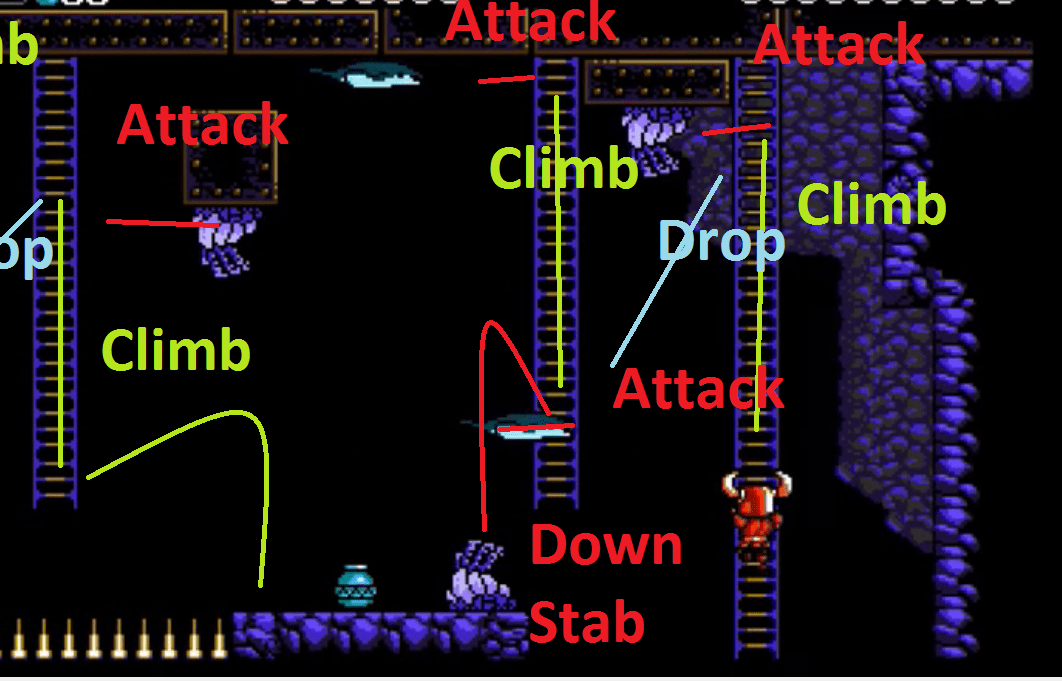
I know I talked about it before, but Shovel Knight is probably one of the few games this year that I was hard-pressed to put down. Aside from being a fun Castlevania-Megaman style Platformer, attached is a great soundtrack, a style that references games of the past but is still able to carve out its own image and gameplay that is never “too easy” or “too hard” but consistently finds the middle ground to keep the player lingering in the “I know I can complete this” mentality.

You've come a long way NES-Dracula. Fighting me in a graveyard instead of near your shining throne.
You’ve come a long way NES-Dracula. Fighting me in a graveyard instead of near your shining throne.

Continue reading “Let’s Talk about: Shovel Knight”

Teaching the Player p2.2 – More on Reactive vs Planned Gameplay

Previous posts in the Series Teaching the Player

And a link to the part 1

Running for Speed

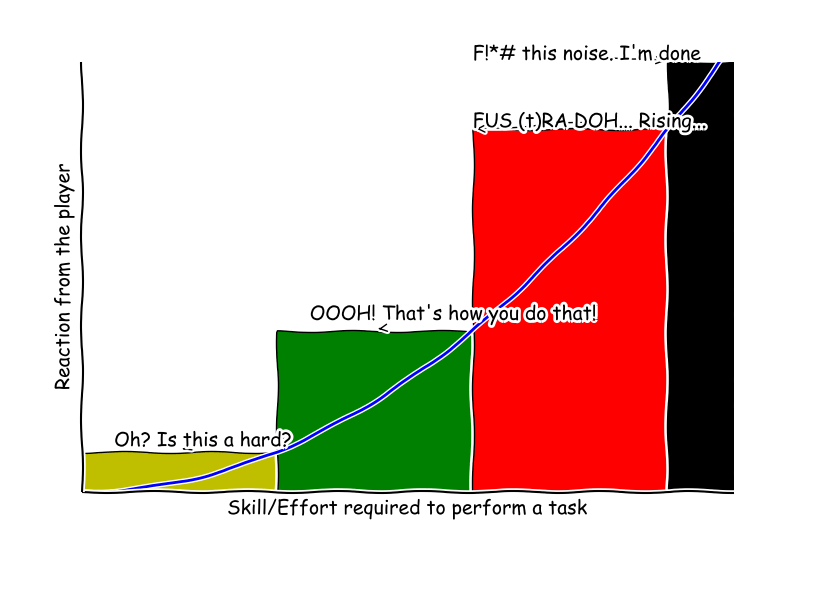
The Speed Running community is a fantastic example of people who take every opportunity to transition all games from a Reaction to Planned Gameplay. They approach every game with its predefined rules and regardless of how well a game teaches you a mechanic, the speed runners put in the time to perfect the most opportune route and routine in getting from the start to the end of the game. They epitomize the idea of “Reaction Gameplay + Time = Planned Gameplay” by learning all of the inadequacies of the player’s abilities and the gamespace’s rules and manipulating them to get a more optimized path for faster completion, and shaving frames, seconds or even minutes off of runtimes by understanding what can be done by the player and what will happen in the gamespace when the player performs the action.

Continue reading “Teaching the Player p2.2 – More on Reactive vs Planned Gameplay”

Teaching the Player p2: Reactive vs Planned Game Design

                Past Articles in the series can be found here


Old Man: It’s dangerous to go it alone. Here, take this.

                Link: But, what am I supposed to do with it?

                Old Man: <shrugs>


Some of the more thrilling parts of life are the times that you’re anxious, you don’t know what’s coming up, but it’s approaching fast and all you can do is traverse yourself through it. You’re given something new and unexpected and you are forced to adapt with the goal of thriving in a new environment. This can also be a source of fear and concern because you aren’t in the normal comfort zone that you once thrived in when getting to this point, yet you’re expected to perform at the high quality that got you to this point? You don’t even know if the rules have changed at this point, the tools being the same, or the uses of any new tools that you may come across.

Of course I’m referring to game design and not my previous post, silly person. But why can’t these causes for frustration and anxiety translate between gaming and real life? If the tools you’re given aren’t explained to you and the tasks that are presented to you require a certain level of proficiency using those tools, how are you supposed to operate at a level of high proficiency?

Continue reading “Teaching the Player p2: Reactive vs Planned Game Design”

E3 Game Dump – Entwined

Entwined_04

Genre: Rhythmic/Atmospheric

Console: PS4. Plans for PS3/Vita Cross-Buy

Controls

Twin stick – asynchronous

The basics are that you move the left stick for the Red character and the right for the Blue. The player then tries to go through the correctly colored gates until their “sync” meter (the top bars) fill up, extend and gently touch tips so they both synergize together.

The Rhythmic part comes in where the gates and sounds played arrive on beat to the background music, making the experience more unique to each player and helps build the atmosphere to each of its soundscapes.

Continue reading “E3 Game Dump – Entwined”

Teaching the player: Prelude and First Screens

You know what sucks in a game? Being force fed how you are supposed to interact with the world. You know what also sucks? Not knowing what to do, or knowing exactly what to do and making it nearly impossible to accomplish. There are a myriad of ways this can be done correctly or incorrectly and I’m sure there were active decisions as to why certain designs were chosen, but they all contribute to or take away from the player experience in one form or another and it’s left to a good level designer to understand what works best for their game and how to design the level around making the most out of the player experience.

Continue reading “Teaching the player: Prelude and First Screens”

Dialogue Delivery p5: How, not what.

Obligatory Past Post Countdown:

Player Paced Dialogue Delivery [link]

Character Paced Non-verbal Dialogue Delivery [link]

Character Paced Verbose Dialogue Delivery [link]

Character Paced Short-Form Dialogue Delivery [link]


Stepping away from the focus on “what” is said, it’s still important to talk about the setting of the delivery. For all of the previous articles, we’ve only talked about dialogue and plot points delivered through extremely disruptive cutscenes. I don’t mean disruptive in the sense that it causes the player to drop the controller out of frustration, but disruptive in that it shifts your agency from playing to watching for a short while. The player stops “playing” the game and starts “watching” the game for a short or extended amount of time. This doesn’t necessarily cause a distraction for the player, but it does give an idea to the pacing of the game for the player. If the cutscenes feel long and troublesome, it can quickly demotivate the player from wanting to continue playing the game. So today, let’s focus on the two major pacing types used in gaming.

Continue reading “Dialogue Delivery p5: How, not what.”

Create a free website or blog at WordPress.com.

Up ↑